
Odoo AI (2026): Features, Use Cases, Implementation, and Comparison to Competitors
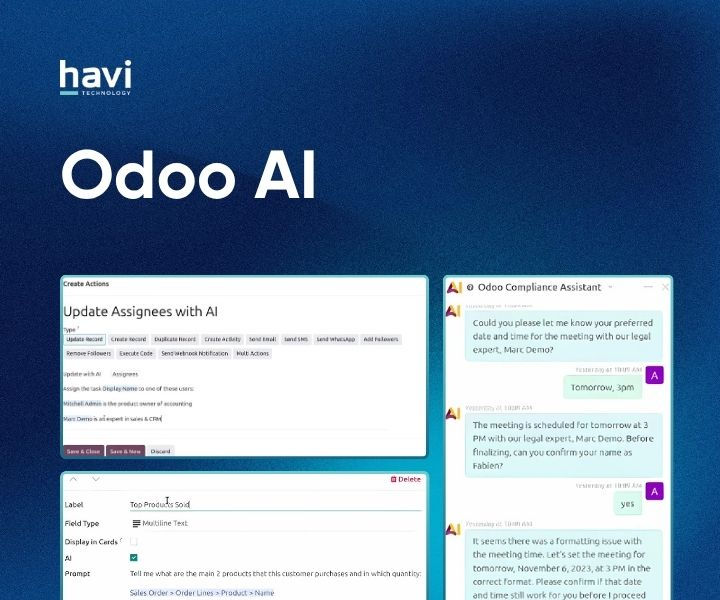
Artificial intelligence is no longer an experimental add-on in enterprise software. By 2026, AI has become a core capability shaping how modern ERP systems operate, make decisions, and scale. Odoo, known for its modular and flexible ERP architecture, has steadily evolved from basic automation toward an AI-augmented business platform.
This article provides a complete, expert-level guide to Odoo AI in 2026—what it is, how it works, where it delivers value, how to implement it responsibly, and how it compares with competing ERP platforms. Whether you are a business leader evaluating ERP strategy, an Odoo administrator planning adoption, or a consultant designing solutions, this guide is written to fully satisfy the search intent behind “Odoo AI.”
1. Understanding Odoo AI in 2026: From ERP Automation to Intelligent Decision Systems
1.1 What “AI in Odoo” Actually Means in Practice
Odoo AI refers to a collection of artificial intelligence capabilities embedded across the Odoo ecosystem to assist users with decision-making, automation, prediction, and content generation. Unlike standalone AI tools, Odoo AI operates within business workflows, using contextual data from ERP records such as customers, invoices, inventory, and projects.
In practice, Odoo AI:
Understands natural language queries and prompts
Predicts outcomes based on historical business data
Extracts and processes unstructured documents
Generates content aligned with real ERP context
Automates actions that previously required manual logic or scripting
1.2 How Odoo’s AI Strategy Has Evolved
Odoo’s journey toward AI can be summarized in three phases:
Rule-based automation – traditional workflows and triggers
Data-driven intelligence – scoring, forecasting, OCR
Context-aware AI assistance – natural language, generative AI, intelligent automation
By 2026, Odoo AI is best understood not as a single feature, but as an intelligence layer across the entire ERP.
1.3 Embedded AI vs Extensible AI
Odoo’s strength lies in offering:
Embedded AI: Native capabilities built directly into core modules
Extensible AI: The ability to integrate third-party or custom AI models
This dual approach gives organizations both out-of-the-box value and long-term flexibility.
2. Core AI Capabilities Built into Odoo (2026 State)
2.1 Natural Language Intelligence
Odoo AI allows users to interact with the system using everyday language. Users can ask questions, generate summaries, draft communications, or trigger actions using prompts that are aware of the current record and user context.
Examples include:
Asking for a summary of a customer’s sales history
Generating follow-up emails based on CRM stages
Explaining complex data in plain language
2.2 Predictive Intelligence
Predictive AI uses historical data to estimate future outcomes. In Odoo, this includes:
Lead scoring and deal probability
Demand forecasting
Inventory replenishment suggestions
Financial trend analysis
These predictions help users prioritize actions instead of reacting late.
2.3 Document Intelligence
Odoo AI processes unstructured documents using OCR and classification techniques. Common use cases include:
Extracting invoice data
Matching bills to purchase orders
Categorizing documents automatically
Reducing manual data entry errors
2.4 Generative Intelligence
Generative AI enables Odoo to create content rather than just analyze it. This includes:
Marketing emails and campaign copy
Product descriptions
Job descriptions and internal documentation
Knowledge base articles
Unlike generic AI tools, Odoo’s generative AI is grounded in actual business data, improving relevance and accuracy.
2.5 Automation Intelligence
AI-driven automation allows non-technical users to define complex actions using natural language instead of code. AI Server Actions and AI Fields enable:
Dynamic field generation
Conditional automation
Cross-module orchestration
This significantly lowers the barrier to advanced automation.
3. Odoo AI by Version: What’s Available and What’s New
3.1 Odoo 17–18: Foundational AI Capabilities
Earlier versions introduced:
OCR-based invoice processing
Lead scoring and forecasting
Basic content generation
Predictive inventory features
These laid the groundwork for broader AI adoption.
3.2 Odoo 19: Platform-Wide AI Enablement
Odoo 19 expanded AI from isolated features into a platform capability, introducing:
Ask AI across multiple apps
AI Fields in Studio
AI Server Actions
Broader use of generative and predictive models
3.3 2026 Directional Roadmap
By 2026, Odoo AI emphasizes:
Deeper context awareness
More transparent AI governance
Better support for external and private AI models
Increased user control over AI behavior
4. Module-Level Use Cases: How Odoo AI Works Across the Business
4.1 CRM & Sales
Odoo AI enhances sales effectiveness by:
Scoring leads based on likelihood to convert
Recommending follow-up actions
Summarizing customer interactions
Drafting personalized outreach emails
Sales teams spend less time analyzing data and more time closing deals.
4.2 Marketing, Website & eCommerce
AI supports marketing teams by:
Generating campaign content
Creating SEO-friendly product descriptions
Translating content for global audiences
Personalizing website messaging
Marketing becomes faster, more consistent, and data-driven.
4.3 Accounting & Finance
In finance, Odoo AI:
Automates invoice processing
Flags anomalies and inconsistencies
Forecasts cash flow
Assists with financial summaries
This reduces manual effort while improving accuracy.
4.4 Inventory & Supply Chain
AI-driven forecasting helps businesses:
Anticipate demand fluctuations
Optimize reorder points
Reduce stockouts and overstock
Improve supplier planning
Supply chains become more resilient and responsive.
4.5 HR & Internal Operations
HR teams use Odoo AI to:
Parse resumes and rank candidates
Draft job postings and offers
Summarize employee data
Assist with internal documentation
This streamlines hiring and internal administration.
4.6 Customer Support & Helpdesk
Support teams benefit from:
AI-suggested replies
Ticket summarization
Knowledge retrieval
Faster resolution times
Customer satisfaction improves without increasing headcount.
5. How to Enable and Use AI in Odoo
5.1 Licensing and Editions
Most native AI features require Odoo Enterprise. Community users typically rely on third-party or custom integrations.
5.2 Activating Native AI Features
Administrators enable AI features through system settings and module configurations. This usually involves:
Enabling AI-related options
Configuring usage limits
Assigning permissions
5.3 Configuring Ask AI, AI Fields, and Server Actions
Key setup considerations include:
Defining where AI assistance is allowed
Creating structured prompts
Controlling automation triggers
5.4 Prompt Design Best Practices
Effective prompts:
Provide clear context
Define expected output format
Include constraints and validation rules
5.5 Governance and Control
Odoo AI supports:
Role-based access
Auditability of AI actions
Human-in-the-loop review processes
Responsible configuration is essential.
6. Odoo AI Architecture & Integration Options
6.1 Native Odoo AI Services
Odoo provides AI services through its internal infrastructure and IAP (In-App Purchase) system.
6.2 Third-Party AI Modules
The Odoo App Store includes modules that add:
Chatbots
Advanced OCR
AI assistants
LLM connectors
6.3 Custom AI Integrations
Advanced users can integrate:
External LLMs
Private AI models
Industry-specific AI services
This makes Odoo suitable for regulated or specialized environments.
6.4 Security and Compliance
Key considerations include:
Data residency
Access control
Model transparency
Regulatory compliance
AI should enhance trust, not compromise it.
7. Business Value & ROI of Odoo AI
Organizations adopting Odoo AI typically see:
Productivity gains through automation
Cost reduction via reduced manual work
Better decisions from predictive insights
Faster execution across departments
SMEs benefit from efficiency, while enterprises gain scalability and control.
8. Odoo AI vs Competitors: How It Compares in 2026
8.1 Odoo AI vs SAP AI
Odoo offers more flexibility and lower cost, while SAP provides deeper enterprise-grade analytics but at higher complexity.
8.2 Odoo AI vs Microsoft Dynamics 365 Copilot
Dynamics integrates tightly with Microsoft tools, but Odoo provides broader customization and modularity.
8.3 Odoo AI vs Oracle NetSuite AI
NetSuite emphasizes financial intelligence, while Odoo delivers broader operational AI across modules.
8.4 Comparative Summary
Odoo stands out for:
Cost-effectiveness
Modular extensibility
Open architecture
Strong balance between usability and power
9. Limitations, Risks, and Responsible Use of Odoo AI
Despite its strengths, Odoo AI has limitations:
AI outputs may be inaccurate or incomplete
Over-automation can reduce human oversight
Data governance requires discipline
Best practice is to use AI as an assistant, not a replacement for human judgment.
10. Strategic Outlook: How Odoo AI Will Shape ERP Adoption Beyond 2026
Odoo AI signals a shift from ERP as a system of record to ERP as a system of intelligence. Organizations that prepare governance, skills, and strategy will gain a long-term advantage.
Frequently Asked Questions About Odoo AI
Is Odoo AI fully autonomous?
No. Human oversight remains essential.
What counts as AI inside Odoo?
Any feature using predictive models, NLP, OCR, or generative systems.
Which modules benefit most?
CRM, Accounting, Inventory, and Support typically see the highest impact.
How does Odoo AI differ from standalone AI tools?
It operates directly within business workflows and ERP data.
Can Odoo AI work without external data sharing?
Yes, through controlled or private integrations.
Final Synthesis: Maximizing Value While Managing Risk
Odoo AI in 2026 represents a meaningful shift in how ERP systems support modern organizations. Rather than functioning solely as systems of record, ERP platforms like Odoo are becoming systems of intelligence—capable of assisting decisions, automating complex workflows, and enhancing productivity across departments.
However, the true value of Odoo AI does not come from activating features alone. It depends on thoughtful implementation, strong governance, and a clear understanding of business objectives. Organizations that succeed with Odoo AI are those that balance innovation with responsibility—using AI to augment human expertise rather than replace it.
From a practical standpoint, this means:
Designing AI usage around real operational needs
Maintaining human oversight for critical decisions
Ensuring data security, compliance, and transparency
Continuously refining AI configurations as the business evolves
At Havi Technology, this perspective reflects how forward-thinking organizations approach ERP and AI adoption: treating AI as a long-term capability embedded into business processes, not a one-time feature deployment. By aligning Odoo AI with strategy, people, and governance, businesses can unlock sustainable efficiency, smarter decision-making, and a competitive edge well beyond 2026.
Source:
Havi Technology (2025). Odoo AI: Features, New App and Advanced AI Solution by Havi For Australia


